
Sunrise in Ankara: The Art of Perfect Menemen and Turkish Breakfast Culture
The call to prayer drifts through my hotel window at dawn, and I'm already awake, anticipating what comes next. In Ankara, Turkey's capital city, breakfast is not a rushed affair of coffee and toast but a sacred ritual that can stretch for hours. And at the center of this morning feast sits menemen—scrambled eggs cooked with tomatoes, peppers, and butter until they achieve that perfect barely-set consistency that makes Turkish breakfast legendary.
I've come to Ankara not for its museums or government buildings, but for its breakfast culture, and specifically to learn the secrets of menemen from home cooks who've been making it since childhood.
The Neighborhood Kahvaltı House
My education begins at a family-run breakfast house in Kızılay, Ankara's central district. The owner, Zeynep Hanım, has been serving kahvaltı—the traditional Turkish breakfast spread—for thirty years. But it's her menemen that draws locals from across the city.
"Menemen is simple, which means every detail matters," she explains, tying her apron as morning customers begin to arrive. "The tomatoes must be ripe but firm. The peppers must have character. The eggs must be fresh. And most importantly, you must know when to stop cooking."
She leads me to her kitchen, where copper pans hang from hooks and the morning sun streams through windows overlooking a courtyard. On the counter: tomatoes from Antalya, green peppers from her brother's garden, eggs from a farm outside the city, and a brick of village butter that will transform everything.
The Tomato Question
In Turkey, menemen inspires the kind of passionate debate usually reserved for politics or football. The primary point of contention: to scramble or not to scramble?
"In Izmir, they mix the eggs completely," Zeynep explains, dicing tomatoes with practiced efficiency. "In Ankara, we prefer to see the yolk and white marbled together. Both are correct. Both are menemen."
The second debate concerns the tomatoes. Some cooks peel them. Others argue the skin adds texture. Zeynep belongs to the peeling camp, briefly blanching her tomatoes before slipping off their skins.
"The sauce must be smooth," she insists. "Tomato skin can be bitter. We want only sweetness."
The Perfect Pan
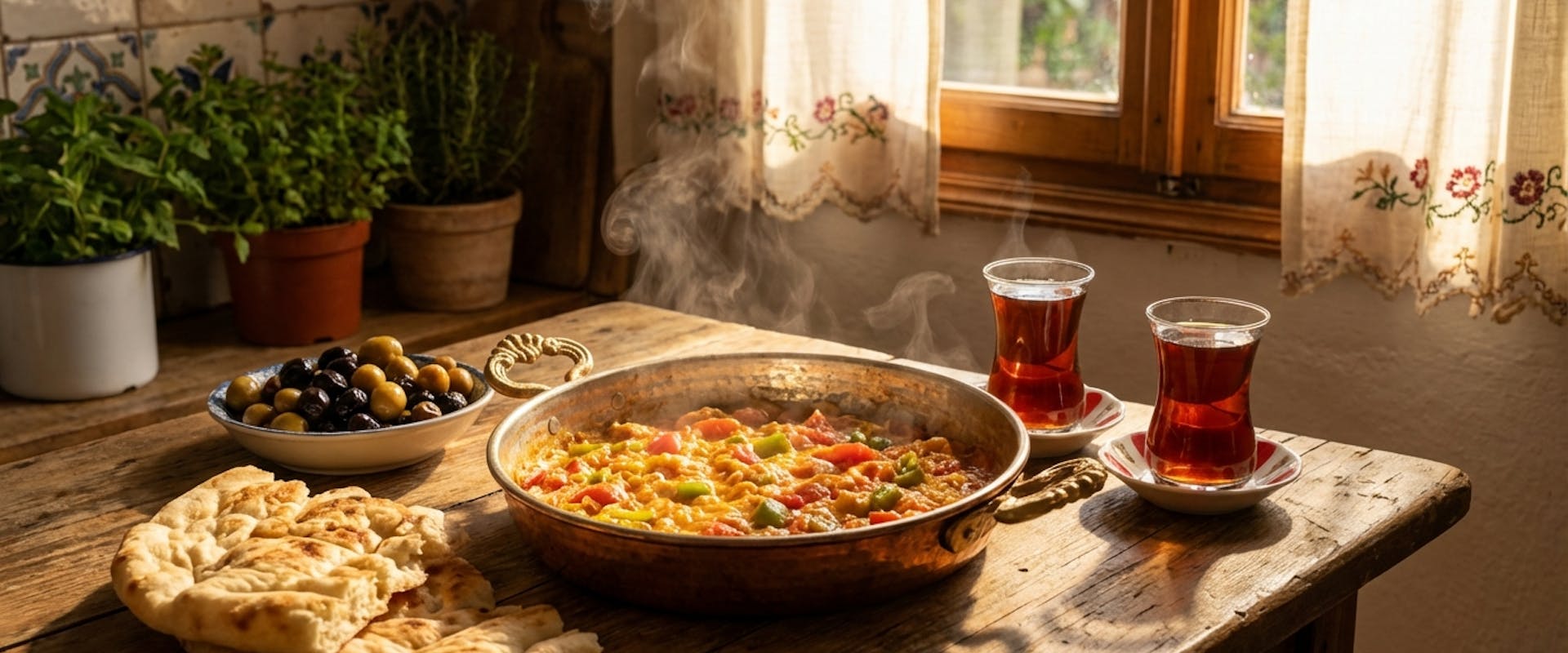
Zeynep heats her copper sahan—a traditional shallow pan with two handles—over medium heat. Into it goes butter, a generous amount that would alarm any Western cardiologist but is essential for authentic menemen.
"Olive oil is acceptable," she concedes, "but butter is traditional. And in Ankara, we respect tradition."
The butter foams, and she adds diced peppers. Not bell peppers, but Turkish green peppers—longer, thinner, with a gentle heat that builds rather than attacks. They sizzle and soften, releasing their perfume into the morning air.
After three minutes, the tomatoes join them. Zeynep has removed most of the seeds and juice, leaving only the flesh. "Too much liquid makes the eggs watery," she warns. "We want concentration, not soup."
The mixture cooks down, tomatoes breaking apart, peppers surrendering to the heat. She adds a pinch of salt, nothing more. "The eggs will bring their own seasoning," she says.
The Egg Moment
Ten minutes later, the tomato-pepper mixture has reduced to a thick, chunky sauce. Zeynep cracks four eggs directly into the pan without beating them first. This is the Ankara style—eggs added whole, then gently stirred to create ribbons of white and yolk throughout the tomato mixture.
"Watch," she instructs, using a wooden spoon to draw the eggs into the sauce with long, sweeping motions. "We don't scramble aggressively. We guide the eggs. We let them find their own way."
The transformation happens quickly. The eggs begin to set, but Zeynep removes the pan from heat while they're still loose and glossy. "Carryover cooking," she explains. "By the time it reaches the table, it will be perfect."
She's right. The menemen that arrives at my table moments later has reached that ideal texture—barely set, creamy, studded with soft pepper and sweet tomato. The eggs are scrambled but distinct, marbled through the vegetables rather than fully incorporated.
A Recipe to Remember
Traditional Ankara-Style Menemen
Ingredients:
- 4 large fresh eggs
- 3 medium ripe tomatoes, peeled and diced
- 2 Turkish green peppers (or 1 green bell pepper), diced
- 40g butter (or 3 tablespoons olive oil)
- Salt to taste
- Fresh bread for serving
- Optional: crumbled feta cheese
Method:
Heat butter in a wide, shallow pan over medium heat until foaming. Add diced peppers and cook for three minutes until softened but not browned.
Add diced tomatoes with most of their juice removed. Season with salt. Cook for eight to ten minutes, stirring occasionally, until tomatoes break down and mixture thickens. The sauce should be jammy, not watery.
Reduce heat to medium-low. Crack eggs directly into the pan without beating them first. Using a wooden spoon, gently fold the eggs into the tomato mixture with long strokes, creating ribbons of white and yolk throughout.
Cook for two to three minutes only, stirring gently and continuously. Remove from heat while eggs are still glossy and slightly underdone. They will continue cooking in the residual heat.
Serve immediately in the cooking pan, accompanied by fresh bread, black olives, white cheese, and tea.
Traditional serving note: In Turkey, menemen is served directly in the cooking pan, placed on a wooden trivet at the table. Diners tear bread and use it to scoop the eggs directly from the pan.
The Complete Kahvaltı Experience
But menemen never arrives alone. Zeynep's breakfast spreads include at least fifteen components: multiple white cheeses (beyaz peynir, kaşar), black olives from the Aegean, tomatoes and cucumbers sliced thick, several varieties of jam, kaymak (clotted cream) with honey, sucuk (spicy sausage), börek (filled pastries), and bread—always bread.
"Breakfast is not food," Zeynep says, pouring black tea into tulip-shaped glasses. "Breakfast is conversation. Breakfast is family. The food is just the excuse to sit together."
I eat slowly, as is the custom, using bread to explore each dish. The menemen is rich with butter, the eggs creamy, the tomatoes sweet. Between bites, I sip tea—strong, unsweetened, the tannins cutting through the richness of the eggs.
Around me, families settle in for hours. Children dip bread in honey while parents debate the day's news. Elderly men play backgammon in the corner. The morning unfolds without urgency.
The Home Kitchen
Later that week, I'm invited to the home of Mehmet Bey, a retired professor who insists on demonstrating his family's menemen technique. His apartment overlooks Ankara Castle, the old city rising on its hill like a memory of empires past.
His method differs from Zeynep's in subtle but significant ways. He beats the eggs before adding them. He uses more pepper. He finishes the dish with a sprinkle of dried mint that adds an herbaceous note I didn't expect.
"Every family has their version," he explains. "My mother made it this way. Her mother made it another way. This is the beauty of menemen—it accepts interpretation."
We eat on his balcony as the sun climbs higher. Ankara spreads below us, a city of four million people, most of whom are probably eating menemen at this very moment.
The Regional Variations
As I travel beyond Ankara, I discover menemen's many faces. In Istanbul, they add kaşar cheese that melts into the eggs. In Izmir, they scramble the eggs completely smooth. In eastern Turkey, they might include spicy sausage or ground meat.
Some cooks add onions. Others consider this heresy. The butter versus olive oil debate rages eternal. But everyone agrees on the fundamentals: fresh eggs, ripe tomatoes, good bread, and the patience to cook low and slow.
The Morning Ritual
On my final morning in Ankara, I return to Zeynep's breakfast house. She recognizes me now, waves me to a table by the window where morning light catches the steam rising from her kitchen.
The menemen arrives in its copper pan, eggs barely set, tomatoes sweet, butter pooling golden at the edges. I tear bread and dip, and for a moment, I'm not a visitor but part of this city's morning rhythm.
"You see?" Zeynep says, refilling my tea glass. "Menemen is not complicated. But it teaches you something about Turkey—we take simple things seriously. We give them time. We share them with others."
The Lesson of Turkish Breakfast
Flying home, I carry a jar of Zeynep's homemade pepper paste and a bag of Turkish tea. But what I really carry is understanding: that breakfast is not meant to be optimized or abbreviated, that eggs deserve attention, that the best meals happen when we slow down enough to notice them.
Somewhere over the Mediterranean, I draft a shopping list: good tomatoes, fresh eggs, proper butter. The menemen I'll make in my own kitchen won't be quite the same as Zeynep's or Mehmet Bey's. It will be mine—another interpretation in menemen's long history.
And isn't that the point? Some dishes travel well precisely because they're generous enough to accept local adaptation while remaining true to their essential nature. Menemen is eggs and tomatoes, yes. But it's also morning light and fresh bread and the radical idea that breakfast deserves our full attention.
The peppers wait. The tomatoes ripen. And somewhere in Ankara, Zeynep is already at her stove, beginning another day of turning simple ingredients into something that makes people linger over their tea, reluctant to leave the table and face the day.
The sahan awaits. The butter is softening. And in that moment when eggs meet tomatoes over gentle heat, Turkey reveals itself—patient, generous, and infinitely welcoming to anyone willing to pull up a chair and stay awhile.