
Laksa Legends: Unraveling Malaysia's Most Complex Comfort Food
The debate starts before you even lift your spoon. Curry laksa or assam laksa? Penang or Singapore style? Thick rice noodles or thin vermicelli? In Malaysia and Singapore, laksa isn't just soup—it's identity, heritage, and the subject of passionate arguments that have lasted generations.
The Origins: A Culinary Collision
Laksa's story begins in the 15th century with the Peranakan people—descendants of Chinese traders who settled in the Malay archipelago and married local women. Their cuisine, known as Nyonya cooking, merged Chinese ingredients and techniques with Malay spices and flavors. Laksa emerged from this cultural fusion, evolving differently in every port city along the Straits of Malacca.
The name itself sparks debate. Some trace it to the Hindi "lakhsha" meaning "many" (referring to the numerous ingredients). Others point to the Persian "laksha" or Chinese "la sha" (spicy sand, describing the paste texture). Like the dish itself, even the etymology is a beautiful mess of cultural exchange.
The Great Divide: Curry vs. Assam
Curry Laksa: The Coconut Embrace
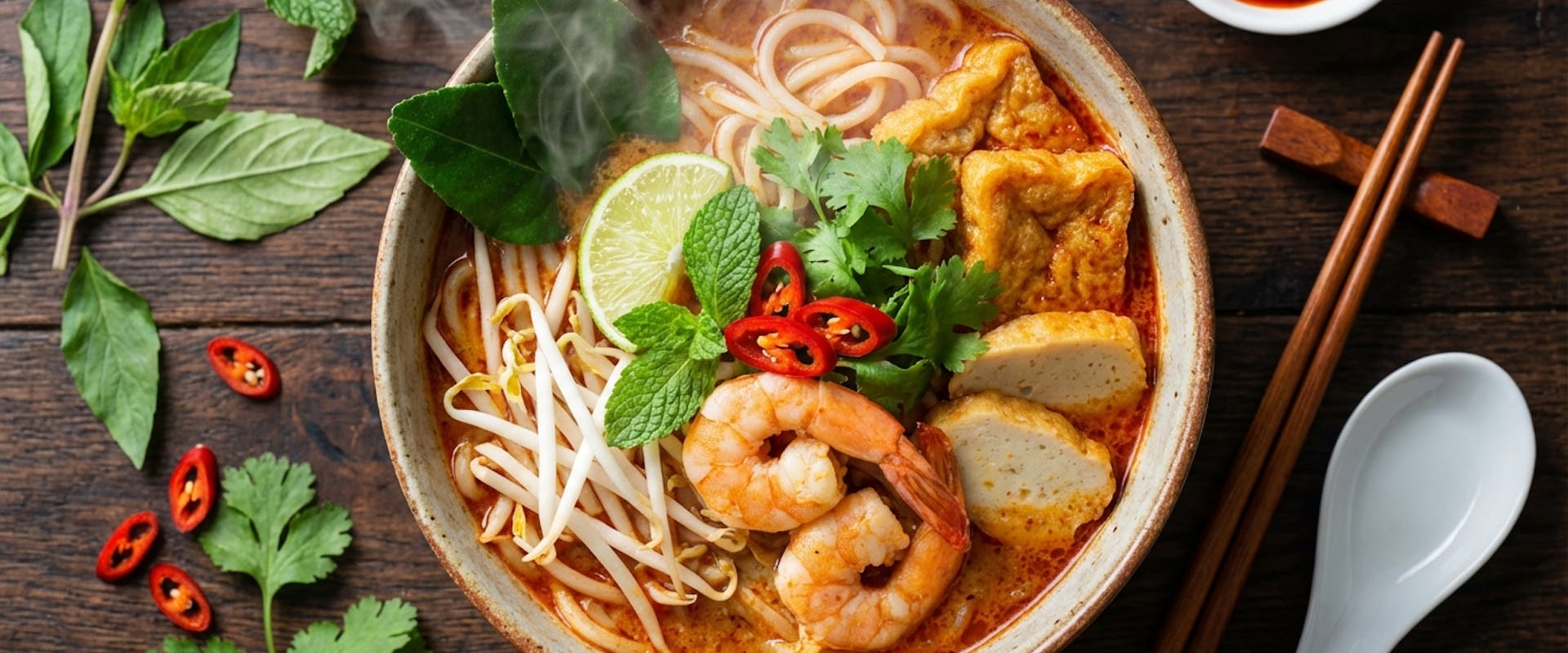
Katong laksa, Singapore laksa, curry laksa—different names for the same philosophy. This version builds its soul around santan (coconut milk), creating a rich, creamy broth that coats your lips and warms from within.
The base begins with rempah—the spice paste that makes or breaks the dish. Toast dried chilies, shrimp paste, lemongrass, galangal, turmeric, candlenuts, and shallots until fragrant, then grind to paste. The traditional method uses a batu giling (stone mill), requiring thirty minutes of circular grinding that awakens the spices' essential oils.
"Modern food processors work faster," admits Uncle Lim at Katong Laksa in Singapore, "but they can't achieve the same texture. Stone-ground rempah has more body, more depth. You taste the difference."
The paste fries in coconut oil until it splits—when the oil separates from the solids, you know the spices are ready. Coconut milk follows, thinned with stock made from prawns, chicken, or both. Some cooks add laksa leaves (Vietnamese coriander), though purists argue this belongs only in assam laksa.
Toppings follow regional rules: prawns always, fish cakes usually, chicken sometimes, cockles if you're brave. Tau pok (fried tofu puffs) soak up the curry like sponges. A hard-boiled egg, halved. Bean sprouts for crunch.
The noodles—thick rice noodles or thin vermicelli, or both—get cut into short lengths. "So you can eat with just a spoon," Uncle Lim explains, demonstrating the one-utensil technique that defines Singaporean laksa.
Assam Laksa: The Sour Truth
Penang's assam laksa takes the opposite path. No coconut milk here—this version builds on tamarind (assam), fish, and a completely different flavor philosophy. If curry laksa comforts, assam laksa awakens.
The fish matters tremendously. Mackerel is traditional—oily, strong-flavored, able to stand up to the assertive broth. The fish simmers until it flakes, then gets picked from bones and stirred back into the broth, creating a thick, fish-forward base.
Tamarind provides the signature sourness, but the spice paste differs entirely from curry laksa. Torch ginger flower (bunga kantan), lemongrass, galangal, chilies, and shrimp paste combine into a paste that smells like tropical rain and tastes like sunshine fermented into liquid.
The broth simmers for hours, developing layers of sour, sweet, spicy, and deeply umami. Vietnamese mint (daun kesum) adds an essential herbal note that defines assam laksa—without it, you've made tamarind fish soup, not laksa.
Topping assam laksa requires precision: thick rice noodles, cucumber strips, pineapple chunks, onion slices, mint leaves, and—controversially—a spoonful of hae ko, the thick, dark shrimp paste that divides diners into lovers and haters. No middle ground exists.
CNN declared Penang assam laksa the world's seventh most delicious food. Penangites shrugged—they already knew.
Regional Variations: The Laksa Diaspora
Sarawak Laksa
Borneo's contribution to the laksa canon uses sambal belacan as its base, creating a paste-like consistency unlike either curry or assam versions. The broth balances coconut milk with tamarind, achieving a rare middle ground between the two major schools.
Sarawak laksa arrives piled with shredded chicken, prawns, egg strips, and bean sprouts, but it's the calamansi lime (limau kasturi) served alongside that makes it distinctive. A squeeze transforms the already complex broth into something transcendent.
Johor Laksa
Southern Malaysia's answer uses spaghetti—yes, spaghetti—instead of rice noodles. The Italian pasta arrived with British influence and somehow stuck. The broth tends toward curry laksa but drier, almost like a curry paste, coating the noodles rather than drowning them.
Fish dominates (tuna or mackerel), joined by cucumber, long beans, and handfuls of rebusan (blanched vegetables). It's laksa's rustic cousin, unpretentious and deeply satisfying.
Mastering the Rempah: Technique Matters
Curry Laksa Spice Paste
Toast First
- 15 dried chilies (mix of chili boh and chili padi for heat)
- 2 tablespoons coriander seeds
- 1 tablespoon cumin seeds
- 5 candlenuts (or macadamia nuts)
- 3 stalks lemongrass (white part only)
- 5cm piece galangal
- 5cm piece turmeric (or 1 tablespoon powder)
- 10 shallots
- 5 cloves garlic
- 2 tablespoons belacan (shrimp paste)
Toast spices and dried chilies in a dry pan until fragrant. Soak chilies in hot water for 15 minutes. Blend all ingredients with a bit of the soaking water until smooth. Stone mill for authentic texture, food processor for convenience.
Cooking the Rempah
Heat 1/4 cup coconut oil over medium heat. Add rempah and fry, stirring constantly, for 15-20 minutes. The paste will darken, deepen, and eventually split—when you see oil pooling around the edges, it's ready. This step cannot be rushed. Under-cooked rempah tastes raw; properly cooked rempah becomes the foundation of complex flavor.
Building the Perfect Curry Laksa
Ingredients (serves 6)
For the broth:
- Prepared rempah (above)
- 1 liter chicken stock
- 800ml coconut milk
- 2 tablespoons fish sauce
- 1 tablespoon palm sugar
- 10 laksa leaves (optional)
For serving:
- 600g thick rice noodles (laksa noodles)
- 300g prawns, peeled and deveined
- 200g fish cake, sliced
- 200g fried tofu puffs, halved
- 4 hard-boiled eggs, halved
- 300g bean sprouts, blanched
- Fresh mint and cilantro
- Sambal belacan on the side
- Lime wedges
Method
Add chicken stock to the cooked rempah, stirring to combine. Simmer for 20 minutes, allowing flavors to meld. Add coconut milk, fish sauce, and palm sugar. Bring back to a gentle simmer—never boil once coconut milk is added, or it will split.
Taste and adjust: it should be rich, slightly spicy, balanced between savory and sweet. Add laksa leaves if using, simmering for 5 more minutes.
Blanch prawns in the simmering laksa broth for 2-3 minutes until pink. Remove and set aside.
To serve: Blanch noodles briefly in boiling water to separate strands. Place in bowls. Add tofu puffs, fish cake, prawns, and egg. Ladle generous amounts of hot laksa broth over everything. Top with bean sprouts, fresh herbs, and a small spoonful of sambal belacan. Serve immediately with lime wedges.
The Street Food Experience
The best laksa rarely comes from restaurants. In Penang, look for the stall near the corner of Carnarvon and Kimberly streets, where the same family has been ladling assam laksa since the 1950s. In Singapore, 328 Katong Laksa draws lines that stretch for hours.
These places share characteristics: no-frills seating (plastic stools, shared tables), rapid turnover, and recipes perfected through decades of repetition. The cook has made this same laksa thousands of times. Their hands remember what their mind doesn't need to think about.
Ordering follows unspoken rules. Specify your noodle type (thick, thin, or both). Add "extra hum" for more cockles, "less spicy" if you're brave enough to admit it. Pay immediately—these aren't places for lingering.
Eat while it's hot. Laksa waits for no one. Mix thoroughly, ensuring the spice paste distributes evenly. Don't be dainty—slurping is expected, encouraged, and practically required.
The Health Paradox
Laksa looks indulgent: coconut milk, fried tofu, oil-slicked broth. Yet Southeast Asians eat it regularly without guilt. The secret lies in balance—the coconut milk's medium-chain triglycerides metabolize differently from other fats. The spices (turmeric, galangal, lemongrass) carry anti-inflammatory properties. The herbs and vegetables add freshness.
Portion control matters. A proper laksa bowl isn't supersized American enormous—it's substantial but not overwhelming. One bowl satisfies, leaves you energized rather than sluggish.
The Vietnamese coriander in assam laksa has been shown to reduce blood sugar spikes. The shrimp paste provides B12 and minerals. The spices aid digestion despite their heat.
Laksa proves that "healthy" and "delicious" aren't opposing concepts. The most vibrant food cultures understand this intuitively.
Making Laksa Paste Ahead
Rempah improves with age. Make a large batch, store it in ice cube trays, and freeze. Each cube represents one serving of paste, ready to fry and transform into laksa at a moment's notice.
The paste keeps frozen for six months. Some cooks insist it tastes better after a few weeks, the flavors melding in ways fresh rempah cannot achieve.
To use: Don't thaw. Drop frozen rempah cubes directly into hot oil and fry as usual. The ice will sizzle dramatically—this is normal and desirable.
The Final Slurp
My last bowl of laksa in Penang comes from a street stall near the clan jetties, where the cook learned from her grandmother, who learned from her grandmother. She works with the efficiency of someone who's made this same bowl ten thousand times.
The assam laksa arrives electric with tamarind, fish flaking throughout the broth, Vietnamese mint so pungent it clears my sinuses. The hae ko sits in a small dish—to add or not is my choice, always my choice.
I add it. The funkiness explodes, completing the flavor circle that defines proper assam laksa: sour, sweet, spicy, herbal, oceanic. Each spoonful reveals new dimensions. This is cooking as culture, as history, as argument and agreement and everything in between.
Across the strait, in Singapore, someone is eating curry laksa with thick noodles and declaring it superior. In Sarawak, they're squeezing calamansi over their hybrid version. In Johor, spaghetti laksa continues its unlikely existence.
They're all right. They're all wrong. That's the beauty of laksa—it belongs to everyone and no one, fixed in tradition yet constantly evolving, simple in concept yet impossible to master.
The only true rule of laksa: eat it hot, eat it often, and never stop arguing about which version is best.