
Khachapuri and Wine Valleys: Georgia's Ancient Culinary Soul
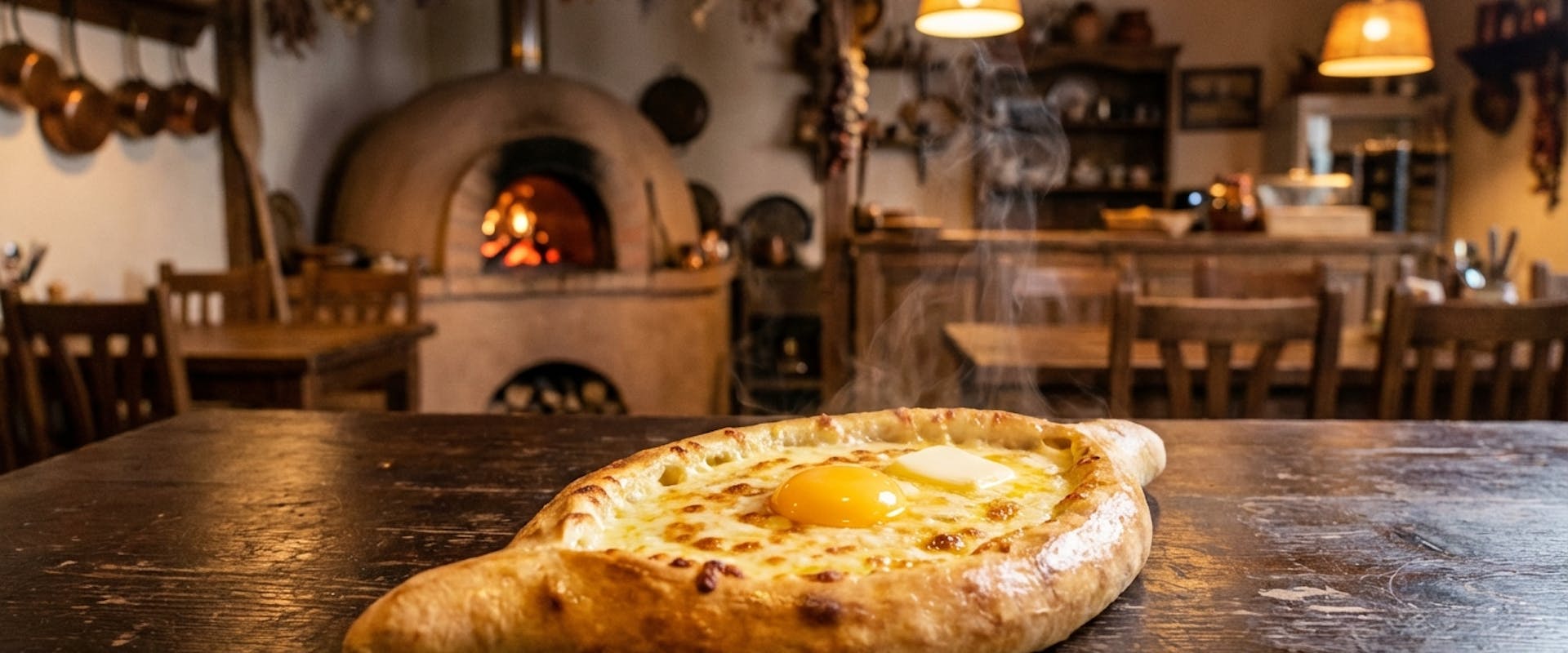
The smell hits you first—melted butter pooling around an egg yolk, sulguni cheese stretching in golden strings, the yeasty warmth of bread just emerged from a tone oven. This is khachapuri, Georgia's national dish, and it arrives at my table in a restaurant tucked into Tbilisi's Old Town like a edible masterpiece.
But khachapuri is just the beginning. Georgia—not the American state, but the Caucasus nation where Europe kisses Asia—has been quietly perfecting its cuisine for millennia while the rest of the world looked elsewhere.
The Khachapuri Pilgrimage
Every region of Georgia claims their khachapuri is the authentic one. In Tbilisi, I taste them all over the course of a week, and each reveals something different about this ancient culture.
Imeruli khachapuri—round, stuffed with cheese, sealed like a pie—comes from the western region of Imereti. The bread is thick and satisfying, the cheese blend of sulguni and imeruli creating that perfect pull when you tear into it.
Megruli khachapuri takes the Imeruli version and doubles down: cheese inside AND on top, creating a golden crust that shatters at first bite.
But it's Acharuli khachapuri that stops me cold. This boat-shaped masterpiece from Adjara arrives still bubbling—a vessel of molten cheese and butter with an egg yolk floating in the center like a golden sun. The server demonstrates: tear pieces from the pointed ends, stir the egg into the cheese, dip, devour.
"The bread is the spoon," she explains with a smile. "Everything is edible. Nothing is wasted."
Regional Khachapuri Styles
Imeruli: Round, cheese-filled, sealed like a pie Megruli: Cheese inside and on top, extra indulgent Acharuli: Boat-shaped with egg and butter, interactive eating Osuri: Rolled with potato and cheese, mountain comfort food Penovani: Puff pastry version, flaky and delicate
Wine from Clay: 8,000 Years of Tradition
In the Kakheti wine region, two hours east of Tbilisi, I descend into a cellar where tradition is measured not in centuries but millennia. Massive clay vessels called qvevri are buried to their necks in the earth floor. These aren't decorative—they're Georgia's original fermentation tanks, unchanged since 6,000 BCE.
"Georgians didn't invent wine," explains winemaker Iago at Pheasant's Tears, an organic winery championing ancient methods. "But we've been making it longer than anyone else, and we never stopped using qvevri."
The wine emerges amber-orange despite being made from white grapes—the result of extended skin contact during fermentation. It tastes like nothing from a bottle: tannic yet fresh, funky yet elegant, tasting of apricots and hazelnuts and something indefinably ancient.
The qvevri method earned UNESCO World Heritage status in 2013, but for Georgians, it's not heritage—it's Tuesday.
Supra: The Feast as Spiritual Practice
You cannot understand Georgian food without experiencing supra—the traditional feast that transcends mere dining to become something closer to ceremony. At a family gathering outside Mtskheta, Georgia's ancient capital, I witness this firsthand.
The table groans under the weight of dozens of dishes: khachapuri, naturally, but also khinkali (soup dumplings with spiced meat), pkhali (vegetable pâtés with walnut paste), badrijani (eggplant rolls with walnut filling), mtsvadi (grilled meat skewers), lobio (kidney beans in clay pots), and satsivi (chicken in walnut sauce).
But the food is merely the stage for the tamada—the toastmaster—who leads a succession of toasts that can number in the dozens. Each toast is a small speech, honoring ancestors, family, peace, love, Georgia itself. Between toasts, conversation flows like the wine—endless, warm, inclusive.
"We don't just feed guests," my host explains, refilling my horn-shaped cup for the eighth time. "We absorb them into family. By the end of supra, you are Georgian."
The Cheese Revelation
Georgian cheese deserves its own pilgrimage. Sulguni—the star of khachapuri—is a brined cheese with a texture between mozzarella and halloumi. Fresh, it's mild and elastic. Smoked, it becomes something transcendent.
In the mountain village of Tusheti, accessible only a few months per year when snow permits, I watch a shepherd make guda—sheep's milk cheese aged in sheepskin bags. The process hasn't changed in centuries. The result tastes like grass and flowers and the wild herbs the sheep graze on.
A Recipe to Carry Home
Acharuli Khachapuri (Adjarian Cheese Boat)
Ingredients:
For the dough:
- 500g all-purpose flour
- 300ml warm milk
- 7g active dry yeast
- 2 tablespoons sugar
- 1 teaspoon salt
- 3 tablespoons butter, melted
For the filling:
- 400g sulguni cheese, grated (or substitute mozzarella + feta mix)
- 200g imeruli cheese or farmer's cheese
- 4 egg yolks
- 4 tablespoons butter
- Salt to taste
Method:
Dissolve yeast and sugar in warm milk, let stand 10 minutes until foamy. Combine flour and salt in a large bowl. Add yeast mixture and melted butter, knead until smooth and elastic, about 10 minutes. Cover and let rise in a warm place for 1 hour until doubled.
Mix the two cheeses together, adding a pinch of salt. The mixture should hold together but still be spreadable.
Divide dough into 4 equal pieces. Roll each into an oval about 25cm long. Place a quarter of the cheese mixture in the center, leaving a 3cm border. Fold the long sides up over the cheese, pinching and twisting the ends to create a boat shape. The center should remain open, exposing the cheese.
Place on parchment-lined baking sheets. Let rest 15 minutes. Preheat oven to 220°C (425°F).
Bake for 12-15 minutes until the bread is golden and cheese is bubbling. Remove from oven, immediately make a well in the center of each boat and drop in an egg yolk. Add a tablespoon of butter. Return to oven for 2-3 minutes—the egg should be just set but still runny.
Serve immediately. To eat: stir the egg and butter into the molten cheese, tear pieces from the bread ends, and dip.
The Khinkali Ritual
No Georgian meal is complete without khinkali, the soup dumplings that test both your technique and your dignity. At Pasanauri in Tbilisi—famous for these pleated pouches—I watch locals demonstrate the proper eating method.
Hold the dumpling by its twisted top knob. Bite a small hole in the side. Suck out the scalding broth. Eat the filling and dough. Discard the knob on your plate—it's your score counter, and locals will judge.
The filling varies: traditional uses a mix of pork and beef with lots of black pepper. Mountain regions add cilantro and more herbs. Vegetarian versions use mushrooms or cheese.
I manage six khinkali before admitting defeat. The grandmother at the next table has a pile of fourteen knobs and is still going.
The Walnut Obsession
Georgian cuisine uses walnuts the way other cultures use butter—as the foundation of richness. Nearly every traditional sauce contains ground walnuts: bazhe (walnut and garlic sauce), satsivi (walnut and spice sauce), nigvziani badrijani (walnut-stuffed eggplant).
The nuts grow everywhere in Georgia. In the countryside, walnut trees shade every courtyard, their massive trunks bearing autumn harvests that families spend weeks processing.
The Adjarian Wine House
In Batumi, on the Black Sea coast, I discover Adjarian wine—less famous than Kakheti's but equally fascinating. The maritime climate creates wines unlike anywhere else in Georgia: crisper whites, more delicate oranges, reds that taste of sea air.
At a small wine house, the owner pours me Chkhaveri, a rare red grape that produces rosé-like wines. It tastes of strawberries and minerals, perfect with the grilled fish arriving from the port.
"This is the wine Romans drank," he says. "We still make it the same way."
The Final Feast
My last Georgian evening unfolds at a family vineyard in Sighnaghi, the hilltop town overlooking the Alazani Valley. The sun sets over the Caucasus Mountains as course after course arrives: fresh cheeses, warm khachapuri, khinkali stuffed with lamb, grilled vegetables in walnut sauce, chicken in aromatic broth.
The tamada begins the toasts. To Georgia. To friendship. To those who came before. To those who will come after. The wine flows from a pitcher that never empties—or perhaps someone keeps refilling it when I'm not looking.
As darkness falls and stars emerge, I understand what makes Georgian cuisine special. It's not innovation or refinement in the modern sense. It's continuity—the unbroken thread connecting present meals to those served 8,000 years ago. It's generosity that borders on overwhelming. It's the belief that food is sacred, that sharing a meal creates bonds, that hospitality is the highest virtue.
The next morning, leaving Tbilisi for the airport, I'm already planning my return. Georgia has spoiled me for ordinary bread, ordinary wine, ordinary hospitality.
Somewhere in the mountains, a shepherd is making cheese in a sheepskin bag. In Kakheti, wine ferments in buried clay. In every kitchen, someone's grandmother is rolling khachapuri dough using her grandmother's technique.
The tradition continues, patient and eternal as the Caucasus itself.